Showing posts with label qualitative research. Show all posts

Saturday, February 26, 2011

On the margins in a high-performing high school: Policy and the Struggling Reader

Franzak, J. (May 2008). On the margins in a high-performing high school: Policy and the struggling reader. Research in the Teaching of English, 42(4). pp. 466-505.

In this article, Franzak sets about to answer the following questions: "What constitutes 'policy' in secondary school reading and literature study" and "In the context of how it is constituted, how does reading/literature policy shape the experience of struggling readers in a traditional high school English class?" (Franzak, 2008, p. 467). She finds there is a disconnect between state/district created policy and its implementation in the classroom, describing implied policy and phantom policies that existed within the district. The focus of analysis is the student participants' understanding of why they read specific literature in language arts class--namely Romeo & Juliet and The Odyssey.

In the discussion of the research, Franzak suggests that the integration of teaching literature and teaching reading needs to be added to teacher education programs as well as educational policy.

Beneath and Beyond the Truth: Studying Literary Narratives to Research Human Phenomenon

Otto, S. (April 2007). Beneath and beyond the truth: Studying literary narratives to research human phenomenon. International Journal of Research and Method in Education 30(1), pp. 73-87.

In this article Otto discusses using literature as data in qualitative research involving the human experience. Otto calls her approach "novel inqury".  She argues that novel inquiry is particularly important in educational research because it may show how individuals contextualize their educational experiences.

I find this idea particularly interesting if only because in EDUC 576 last semester, I referenced multiple young adult novels to illustrate points about how teachers, students, and society as a whole, view the concept of bullying.

Saturday, December 25, 2010

Dialogic narratives of literacy,teaching and schooling

Rogers, T., Marshall, E. & Tyson, C. A. (2006, April/May/June). Dialogic narratives of literacy,teaching and schooling: Preparing literacy teachers for diverse settings. Reading Research Quarterly, 41(2), pp. 202-224.

​The purpose of this article is to examine how dialogue plays a role in pre-service teacher’s development. The study takes place within a Master of Education program and looks at 10 students who participated in a program designed around literacy instruction and preparing educators for teaching literacy in a variety of contexts. Of the ten participants, the researchers chose to focus on two participants whose stories are told throughout the study. In looking at two students, the researchers were able to look at how pre-service teachers construct their identities as teachers and how they position themselves with the educational system.


- Posted using BlogPress from my iPad

Engaging student researchers and teacher researchers in the process of data analysis

Merritt, S. P. (2004, May). Engaging student researchers and teacher researchers in the process of data analysis. Language Arts, (81)5, pp. 406-416.

Merritt says the hardest, most daunting part of research is the data analysis. It is important for novice researchers to examine what it is they bring with them to the study. She suggests that researchers reflect on their study, writing about the assumptions they have, which aids in recognizing bias. She also suggests that researchers keep a journal and confer with other researchers as a method of uncovering their biases and adding to the validity of the study they’re conducting. Novice researchers must understand their theoretical framework as a way to see the research and the reason for the research questions asked in their studies.

This article connects directly to what I’ve learned in EDUC 576 about qualitative research but is discussed in a manner that is very readable for a teacher-researcher. The author does not directly discuss aspects like positionality or validity, but the methods she has her students use to examine their assumptions and biases lend themselves to guiding students to understand their position in relationship to the research and participants, as well as ensuring that their analysis is valid.


- Posted using BlogPress from my iPad

Tuesday, October 12, 2010

Trouble with interview questions

So thus far, my research team's research questions are as follows:

NewImage.jpg

The trouble I'm having is that in writing the interview questions, they all seem to focus on questions 3 and 4 (yes, I know they're not numbered. Count them). I think the first question gets answered through document analysis in conjunction with data we collect for questions 3 and 4. I'm honestly not sure how we're going to answer the second. Maybe, again, in students' answers to the interview questions, but indirectly so. And then four and five. And I've thought of some questions while writing this post, so I'm going to get back to that.

Thursday, October 7, 2010

Things to work on

We were reading articles about bullying in qualitative research class last night and through the discussion surrounding these articles I came up with two things I need to work on in terms of how I read. First, I need to learn to read literature reviews for the gaps in the literature. Second, I need to learn to notice researchers subjectivities--and how their biases appear in their research.


- Posted using BlogPress from my iPad

Wednesday, September 22, 2010

Questions in Qualitative Research

From our discussion of qualitative research

  • Shortcomings of qualitative research questions is that they're often too focused.
  • Don't have enough flexibility of research questions
  • Should be broad enough that we can go into specifics but can change at the same time
  • components of a research question
    • context
    • participants (community)
  • hardest thing to come to is initial question

As we get to our findings, the research questions change. That makes qualitative research and dissertation antithetical because we have to write a proposal in which research questions are set. Even though the questions change due to the research.

Theoretical framework guides research questions. (Finally! An order!)

The literature review comes out of the ideas of the research questions. The way the questions are analyzed become the legs of the literature review.

*Note: Grounded theory is a theoretical framework and a methodology--it also means the "absence of theory."

What we ask ourselves with research questions:

  • Is it a yes/no question? 
    • Questions with the word "can" can get you in trouble
    • Use words like how, how do
    • We are concerned with how people make meaning in qual. research
  • Are there multiple things going on in the question?
  • What assumptions are we making about ideas or groups of people?
  • Are there ideas to correlation between two or more topics (that's kinda quantitative, innit?)
  • Is it looking at the phenomenon I'm interested in?
  • Where do I get my literature?
  • Which question (of the subquestions) is your "so what" question. Marshall and Rossman (2010) call it "should-do-ability"

Friday, September 3, 2010

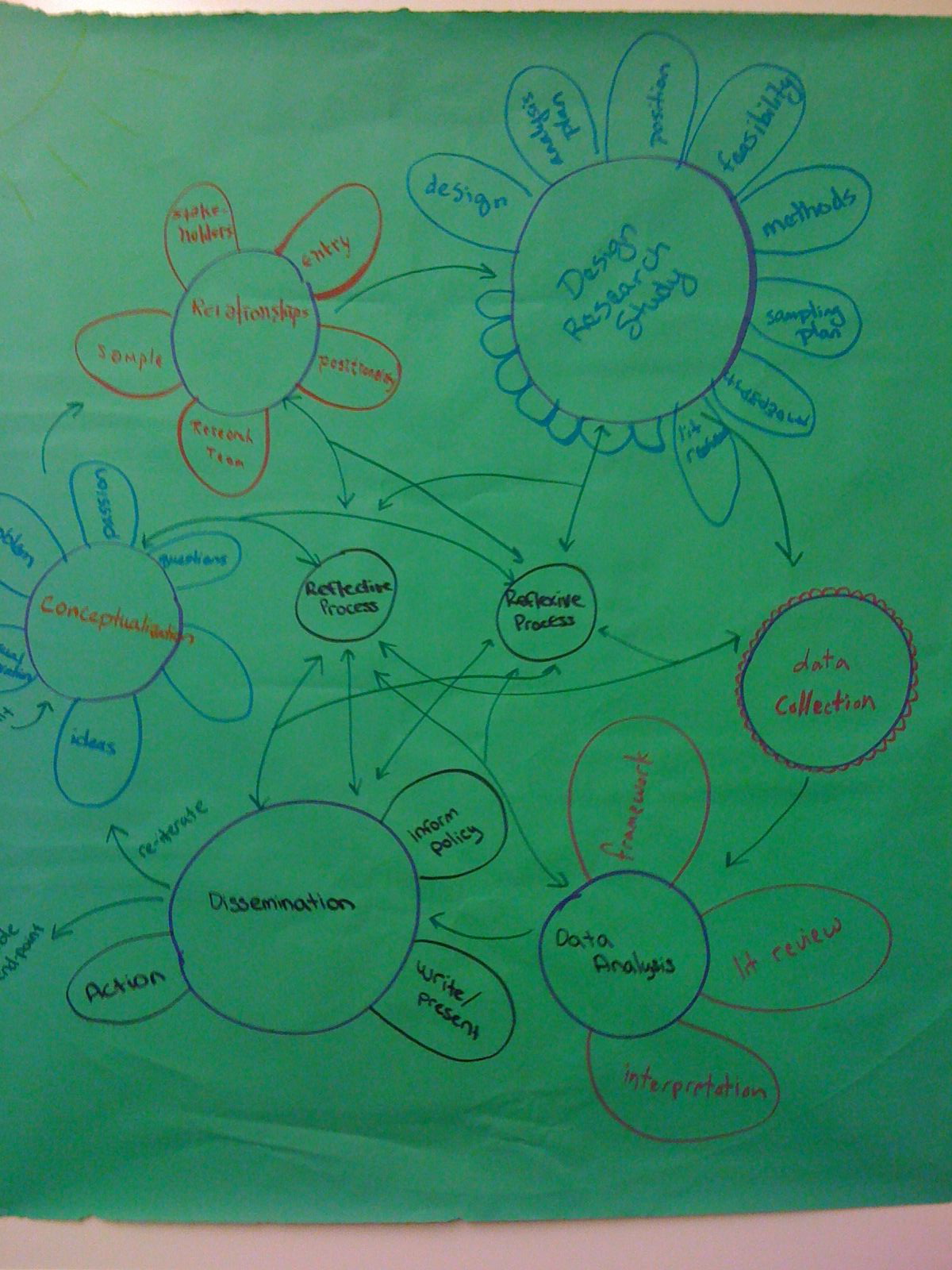
Conceptualizing Qualitative Research

Mobile Photo Sep 2, 2010 1 45 01 PM.jpg

In class, last night, we were asked to take what we learned about research study design and create a visual representation of what we determined to be the most important points. Brief explanation of that which isn't clear:

  • The arrows point to the reflexive and reflective processes, which are ubiquitous in the research process. At any point, the researcher may change direction/methods/etc because of what they discover during these processes.
  • In reflecting on our drawing during presenting to the class, we added petals to the flower labeled "Data Collection." Some example petals are questionnaires, interviews, videos, and surveys.

Through our conversations surrounding presentations of the visuals we created a number of questions were presented and answered about the research process and the language we use to describe it.

Reflection and reflexivity are processes where the researcher thinks about themselves and their relationship to the project as a whole. The purpose is to make sure the researcher is aware of his positionality and how that affects his research. The iterative process, however, is reflection that involves repeating processes (though not always in the same way). I see the iterative process kind of like this:

Steel-Spiral-Ring.jpg

(From http://goo.gl/LhZG)

So we can conclude that research is very much not a linear process. I wanted to create a flowchart to make it more linear, but even that seemed way too complicated. So I guess I'll stick with the flowers.

Qualitative research is contextually bound. There is no guarantee that the results will be transferrable to other situations, but the theories that come out of the research should be patterns that are applicable to observations in other places. That is what makes qualitative research transformable.

As researchers, we have to get to the point where we understand (and practice) the idea that absolutely everything we do is intentional. Because we have to justify more than quantitative researchers do, we have to be able to explain to people why we made the choices that we made. Every choice or occurrence (e.g. people not returning permission forms) affects the outcome of the study. As researchers, we have to be very aware, and make a point to talk about, the limitations of the study due to these choices or other things that happen through the course of the study.

One of my tasks following this posting is to go back and look at the article I read last week on bullying and examine at it more critically in terms of what we decided was important.

Saturday, August 28, 2010

Miscue Analysis

While RDG 621 is formally a class about literacy assessment and evaluation, the main assessment too that students learn and perform in this class is miscue analysis. Our class is held at New Mexico State's Children's Village, where we spend half the class learning about literacy by interacting with children.

Miscue analysis is a process developed by Ken Goodman (who wrote one of our textbooks). Simply put, it's the process used to determine both a reader's strengths and the strategies the reader needs to work on.

Unlike many assessment tools, miscue analysis is a mixed methods way of conducting research, possessing qualities that are both quantitative and qualitative. On the quantitative side, miscue analysis provides statistical information in the quantity and frequency of miscues. On the qualitative side, miscue analysis tells the evaluator about the quality of a reader's reading.

Right now, I have a working knowledge of the three cuing systems people use when they read. A fundamental understanding of these cuing systems is important when conducting miscue analysis. My goal for the semester is to build my knowledge of these cuing systems so when I am conducting an informal miscue analysis while listening to my students read, I can call up my knowledge of these cuing systems to help me further guide my students.

The three cuing systems are:

  • Graphophonic: this system involves the way words are spelled, punctuation, and other print features, as well as the sounds of oral language and their relationship
  • Semantic: this system deals with the meanings of words and phrases, how they relate to each other and both the author's and reader's knowledge of the world.
  • Syntactic: this system involves the way people organize their words in phrases or sentences in any given language. The grammar of a language, if you will.

Goodman, Y., et. al. (2005) Reading Miscue Inventory. Katonah, NY: Richard C. Owen Publishers, Inc.