I think I need to add this book to the ones I read yearly. While Friere tends to write in circles, I keep coming back to a few key ideas that he presents, and discovering more as I learn. My favorite letter, the one that transformed my teaching the first time I read it was the one about moving from talking to learners to talking with them and from listening to them to hearing them. I know it comes from a social justice perspective, and maybe it's also social justice in the context of my classroom, but I've learned that I get so much more out of kids if I take the time to listen to what they have to say, then use that to make my book recommendations. It's harder to listen to some kids than others, since they've been so disillusioned by the system that they lack the trust or respect for educators, but that's a no-longer-blind-spot that I'm going to have to deal with as an educator.
Sunday, February 6, 2011


Sunday, December 26, 2010
Always On
Baron, N. S. (2008). Always on: Language in an online and mobile world [Kindle DX Reader version]. Retrieved from http://www.amazon.com
"In Always On, Naomi S. Baron reveals that online and mobile technologies--including instant messaging, cell phones, multitasking, Facebook, blogs, and wikis--are profoundly influencing how we read and write, speak and listen, but not in the ways we might suppose. Baron draws on a decade of research to provide an eye-opening look at language in an online and mobile world. She reveals for instance that email, IM, and text messaging have had surprisingly little impact on student writing. Electronic media has magnified the laid-back "whatever" attitude toward formal writing that young people everywhere have embraced, but it is not a cause of it. A more troubling trend, according to Baron, is the myriad ways in which we block incoming IMs, camouflage ourselves on Facebook, and use ring tones or caller ID to screen incoming calls on our mobile phones. Our ability to decide who to talk to, she argues, is likely to be among the most lasting influences that information technology has upon the ways we communicate with one another. Moreover, as more and more people are "always on" one technology or another--whether communicating, working, or just surfing the web or playing games--we have to ask what kind of people we are becoming, as individuals and as family members or friends, if the relationships we form must increasingly compete for our attention with digital media." --from Amazon.com
Reading this text did bring a sense of awareness to the way I interact and the way my students interact with people (or even choose not to interact with people) using technology. It often isn't enough to be engaged in one activity. With the proliferation of mobile technology, it is increasingly more "necessary" to be engaged in more than one activity at a time. But what does this multitasking to do to the quality of the activity we are engaged in, whether it be writing a paper or talking with a friend or parent on the phone?
Sunday, November 28, 2010
Outrageous Textbook Prices

I did a little more digging and found something different. I wandered over to Amazon.com to see if the used copies through other resellers were cheaper than what B&N was advertising. Here is what I found:

Um, huge discrepancy anyone? With Amazon providing all Kindle apps for free, I'm not sure why anyone would pay the $135 for a nookStudy version. I think I'll use the rest of that $119 to pick up the rest of my books.
Unfortunately, there are no books currently posted for my other class. I guess we'll have to wait and see how much damage is done then.
Wednesday, September 22, 2010
Questions in Qualitative Research
From our discussion of qualitative research
- Shortcomings of qualitative research questions is that they're often too focused.
- Don't have enough flexibility of research questions
- Should be broad enough that we can go into specifics but can change at the same time
- components of a research question
- context
- participants (community)
- hardest thing to come to is initial question
As we get to our findings, the research questions change. That makes qualitative research and dissertation antithetical because we have to write a proposal in which research questions are set. Even though the questions change due to the research.
Theoretical framework guides research questions. (Finally! An order!)
The literature review comes out of the ideas of the research questions. The way the questions are analyzed become the legs of the literature review.
*Note: Grounded theory is a theoretical framework and a methodology--it also means the "absence of theory."
What we ask ourselves with research questions:
- Is it a yes/no question?
- Questions with the word "can" can get you in trouble
- Use words like how, how do
- We are concerned with how people make meaning in qual. research
- Are there multiple things going on in the question?
- What assumptions are we making about ideas or groups of people?
- Are there ideas to correlation between two or more topics (that's kinda quantitative, innit?)
- Is it looking at the phenomenon I'm interested in?
- Where do I get my literature?
- Which question (of the subquestions) is your "so what" question. Marshall and Rossman (2010) call it "should-do-ability"
Friday, September 3, 2010
Conceptualizing Qualitative Research
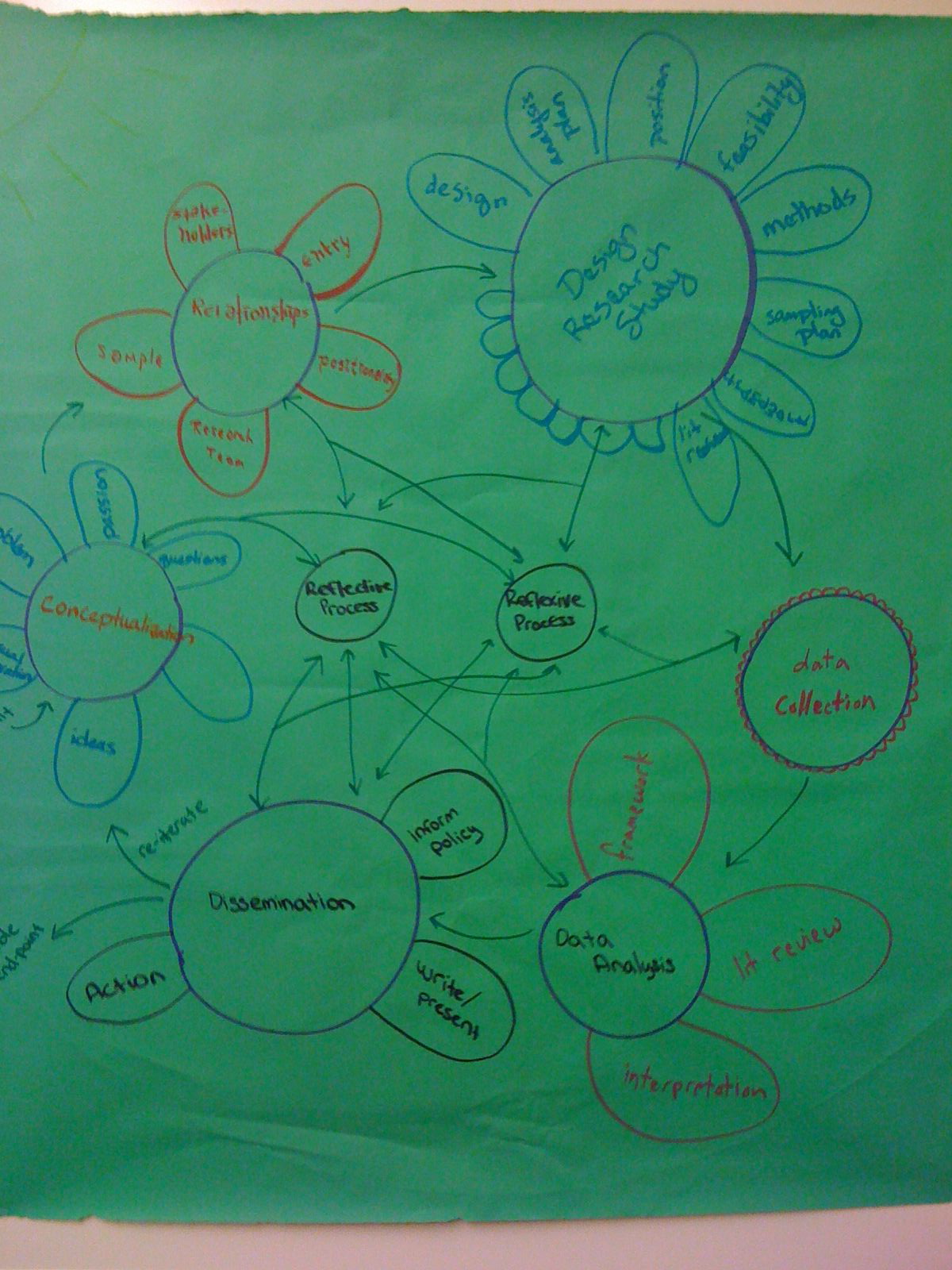
In class, last night, we were asked to take what we learned about research study design and create a visual representation of what we determined to be the most important points. Brief explanation of that which isn't clear:
- The arrows point to the reflexive and reflective processes, which are ubiquitous in the research process. At any point, the researcher may change direction/methods/etc because of what they discover during these processes.
- In reflecting on our drawing during presenting to the class, we added petals to the flower labeled "Data Collection." Some example petals are questionnaires, interviews, videos, and surveys.
Through our conversations surrounding presentations of the visuals we created a number of questions were presented and answered about the research process and the language we use to describe it.
Reflection and reflexivity are processes where the researcher thinks about themselves and their relationship to the project as a whole. The purpose is to make sure the researcher is aware of his positionality and how that affects his research. The iterative process, however, is reflection that involves repeating processes (though not always in the same way). I see the iterative process kind of like this:

(From http://goo.gl/LhZG)
So we can conclude that research is very much not a linear process. I wanted to create a flowchart to make it more linear, but even that seemed way too complicated. So I guess I'll stick with the flowers.
Qualitative research is contextually bound. There is no guarantee that the results will be transferrable to other situations, but the theories that come out of the research should be patterns that are applicable to observations in other places. That is what makes qualitative research transformable.
As researchers, we have to get to the point where we understand (and practice) the idea that absolutely everything we do is intentional. Because we have to justify more than quantitative researchers do, we have to be able to explain to people why we made the choices that we made. Every choice or occurrence (e.g. people not returning permission forms) affects the outcome of the study. As researchers, we have to be very aware, and make a point to talk about, the limitations of the study due to these choices or other things that happen through the course of the study.
One of my tasks following this posting is to go back and look at the article I read last week on bullying and examine at it more critically in terms of what we decided was important.
Monday, August 30, 2010
Observing the Reading Process (RMI, Chapter 1 notes)
"An additional purpose of miscue analysis is to help teachers and researchers evaluate reading material" (p. 4)
Through the Burke Interview (p. 13) teachers can find out how children perceive themselves as readers.
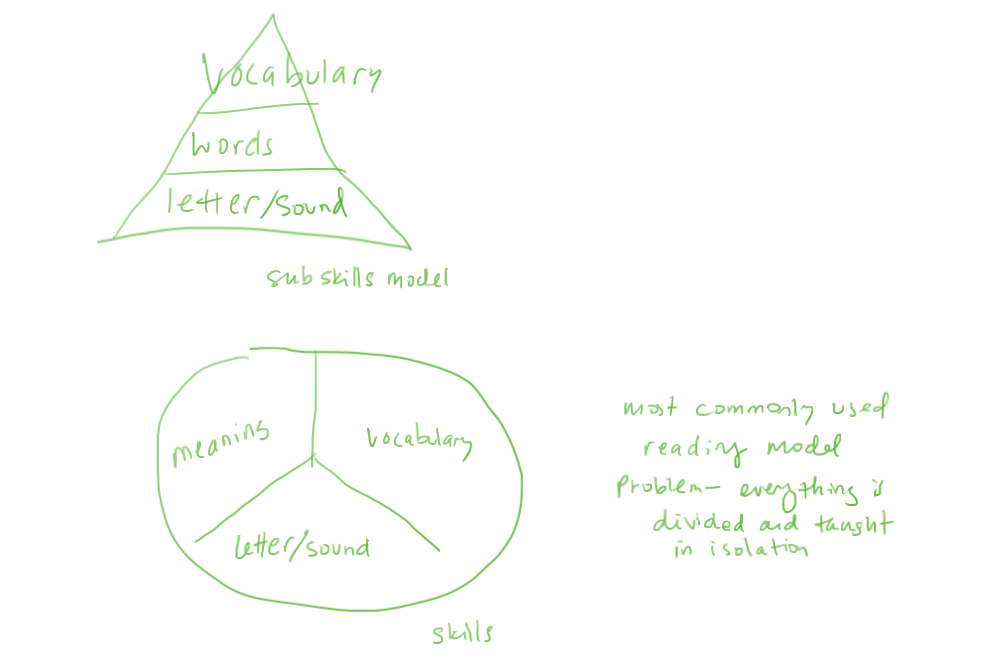
Reading Models
- Bottom-up mdoel
- Top-down model
- Interactive model
- Subskills model
- Skills model
- Holistic
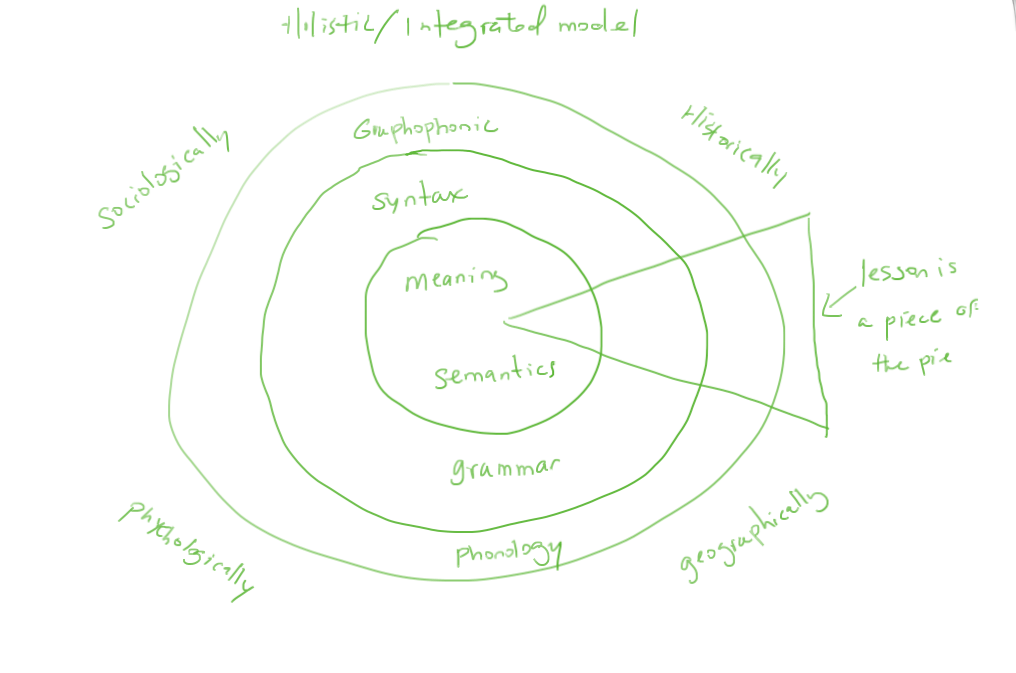
Language Cuing Systems
Semantic cuing system
- The system of meanings in a language
- The question: Does this make sense?
- Interrelationships of words, sentences, and paragraphs within a coherent text.
- The question: Does this sound like language?
- The system of social rules that lets us know what language is acceptable and expected in particular settings. (Social knowledge)
- The question: what might someone say in this situation?
- The set of relationships between the sounds and the written forms of the language.
- The question: How do these letters and their sounds help me choose a word that makes sense here?
Goodman, Y., et. al. (2005). Reading Miscue Inventory. Katonah, NY: Richard C. Owens Publishers, Inc.
Saturday, August 28, 2010
Miscue Analysis
While RDG 621 is formally a class about literacy assessment and evaluation, the main assessment too that students learn and perform in this class is miscue analysis. Our class is held at New Mexico State's Children's Village, where we spend half the class learning about literacy by interacting with children.
Miscue analysis is a process developed by Ken Goodman (who wrote one of our textbooks). Simply put, it's the process used to determine both a reader's strengths and the strategies the reader needs to work on.
Unlike many assessment tools, miscue analysis is a mixed methods way of conducting research, possessing qualities that are both quantitative and qualitative. On the quantitative side, miscue analysis provides statistical information in the quantity and frequency of miscues. On the qualitative side, miscue analysis tells the evaluator about the quality of a reader's reading.
Right now, I have a working knowledge of the three cuing systems people use when they read. A fundamental understanding of these cuing systems is important when conducting miscue analysis. My goal for the semester is to build my knowledge of these cuing systems so when I am conducting an informal miscue analysis while listening to my students read, I can call up my knowledge of these cuing systems to help me further guide my students.
The three cuing systems are:
- Graphophonic: this system involves the way words are spelled, punctuation, and other print features, as well as the sounds of oral language and their relationship
- Semantic: this system deals with the meanings of words and phrases, how they relate to each other and both the author's and reader's knowledge of the world.
- Syntactic: this system involves the way people organize their words in phrases or sentences in any given language. The grammar of a language, if you will.
Goodman, Y., et. al. (2005) Reading Miscue Inventory. Katonah, NY: Richard C. Owen Publishers, Inc.
Sunday, August 22, 2010
Memo on researcher identity
The purpose of this memo is to begin a conversation with myself about the personal relevance of the research I'm planning and why I care about it.
Lutrell poses four questions to help jumpstart this process.
• What are your passions? What makes you care about the topic or the people, places or things that you wish to study?
I am passionate about young adult literature. There's something that I haven't put my finger on yet about the characters, the settings, the writing that speaks to me. And I am passionate about the adolescents who read these novels, who don't want to read these novels, who struggle with literacy in their native language and/or in a new language. There is an excitement that can't be replicated anywhere else when a self-professed non-reader sends me a text message asking for the release date for the next book in the series he's spent the semester reading.
I'm a reader. I've always been a reader. There are days when I can't help but wonder if my passion for young adult literature came from the fact that as an adolescent, my self-selected reads were adult fiction and the classics.
I take immense pleasure in recommending YA titles to my students, discussing their reading and helping them build their literacy not only in an academic setting but outside of school as well.
• What presumptions and beliefs do you hold about the topic, people, places or things?
I assume that every adolescent can find something to read that they can identify with. I believe that most people need to be at least functionally literate to get by in society without being taken advantage of. I believe that some YA literature is as rich in language, characterization and story as the classics English teaches are required to teach. (Don't misunderstand, I also believe that the classics have merit.)
I assume that many struggling readers want to read better, but they're so used to where they are, and many are embarrassed about being behind, that they're paralyzed. I believe that YA literature is becoming increasingly popular (e.g. The hype behind the releases of the Harry potter books and of Mockingjay by Suzanne Collins) with not only adolescent readers, but adult readers as well.
The other two questions, I can't answer yet, but I'll put them here for future reference:
• What is currently preoccupying your mind as you begin your research?
• What are your predilections and preferences as a researcher?
Luttrell, W. (2010). Qualitative Educational Research. New York: Routledge.
- Posted using BlogPress from my iPhone
Thursday, August 5, 2010
Year One, Fall Classes
RDG 621 is cross listed with RDG 511, which I took as a master's student. Of the five texts required for the class, four are the same. The most interesting part of RDG 511 was the mini-lesson in the eye movement lab, which shed some light on how we process what we see when we read. I hope to pull something new from this class, and I hope that the doctoral section is not the add-one-project-and-call-it-600 as master's classes cross listed with undergrad classes were.
As for EDUC 576... The professor was my master's advisor and I liked her. My current advisor says that she's really tough, so I'm expecting this class to be a challenge. I feel unprepared when it comes to conducting and reading research; hopefully this class will help me build the confidence I'm going to need to get through this.