Wurr, A., Theurer, J. L., & Kim, K. (2008, December). Retrospective miscue analysis with proficient adult ESL readers. Journal of Adolescent & Adult Literacy (52)4, pp. 324-333. doi:10.1598/JAAL.52.4.5
In this case study, three non-native English speakers are taken through the process of retrospective miscue analysis. These readers are proficient readers of English. The purpose of the article is to show the benefits of retrospective miscue analysis—of why understanding one’s miscues is important. Retrospective miscue analysis changed the self-perceptions of all of the readers involved in the study. They all left the study more confident in their reading in English than they were when they went into the study.
- Posted using BlogPress from my iPad
Showing posts with label miscue analysis. Show all posts
Showing posts with label miscue analysis. Show all posts
Saturday, December 25, 2010


Viewing eye movements
Paulson, E. J. (2005, July/August/September). Viewing eye movements during reading through the lens of chaos theory: How reading is like the weather. Reading Research Quarterly, 40(3), pp. 338-358. doi:10.1598/RRQ.40.3.3
In this article, Paulson examines the reading process using an analogy of the chaos theory to explain what is difficult to explain within a theory that is systematic and linear. He describes the nature of eye movements while reading, suggesting that data collected about eye movements is the reading side of the analogy. By analyzing where a reader pauses during reading, researchers learn about the processes of comprehension. And by combining eye movement data with miscue analysis, the data about reading is validated. He also suggests that reading is a nonlinear process. Within this article as well are references to other authors write about schema theory and the importance of a reader’s prior knowledge.
- Posted using BlogPress from my iPad
In this article, Paulson examines the reading process using an analogy of the chaos theory to explain what is difficult to explain within a theory that is systematic and linear. He describes the nature of eye movements while reading, suggesting that data collected about eye movements is the reading side of the analogy. By analyzing where a reader pauses during reading, researchers learn about the processes of comprehension. And by combining eye movement data with miscue analysis, the data about reading is validated. He also suggests that reading is a nonlinear process. Within this article as well are references to other authors write about schema theory and the importance of a reader’s prior knowledge.
- Posted using BlogPress from my iPad
Miscue analysis for classroom teachers
Goodman, Y. (1995, November). Miscue analysis for classroom teachers: Some history and some procedures. Primary Voices K-6, 3(4), pp. 2-9.
Miscue analysis for classroom teachers provides an overview of the miscue analysis process—both methods and rationale. The article also provides simple examples of miscues and explains the different cuing systems readers use when they read. The examples are explicated to give the reader, a teacher unfamiliar with miscue analysis, a foundation for further reading and practicing miscue analysis.
- Posted using BlogPress from my iPad
Miscue analysis for classroom teachers provides an overview of the miscue analysis process—both methods and rationale. The article also provides simple examples of miscues and explains the different cuing systems readers use when they read. The examples are explicated to give the reader, a teacher unfamiliar with miscue analysis, a foundation for further reading and practicing miscue analysis.
- Posted using BlogPress from my iPad
Kid watching
Goodman, Y. (1978, June). Kid watching. National Elementary Principal, 57(4), pp. 41-55.
Goodman asserts that children learn language through their natural environment, thus testing that language development is inappropriate. Language learning is like testing a hypothesis: a language learner makes hypotheses about language and adjusts responses based on the responses they receive in their environment. Standardized testing does nothing to aid in language development. If anything, it stifles a child’s development. Goodman stresses that watching kids is the best way to assess their development and that observing mistakes in language usage over time can show how a child is developing. Additionally, kid watchers must take dialect and culture into account when taking assessments.
When I approached this article, I thought the information would be out of date. Instead, it holds consistent with other texts and research on miscue analysis and kid watching both by Goodman and by other authors.
- Posted using BlogPress from my iPad
Goodman asserts that children learn language through their natural environment, thus testing that language development is inappropriate. Language learning is like testing a hypothesis: a language learner makes hypotheses about language and adjusts responses based on the responses they receive in their environment. Standardized testing does nothing to aid in language development. If anything, it stifles a child’s development. Goodman stresses that watching kids is the best way to assess their development and that observing mistakes in language usage over time can show how a child is developing. Additionally, kid watchers must take dialect and culture into account when taking assessments.
When I approached this article, I thought the information would be out of date. Instead, it holds consistent with other texts and research on miscue analysis and kid watching both by Goodman and by other authors.
- Posted using BlogPress from my iPad
Monday, August 30, 2010
Observing the Reading Process (RMI, Chapter 1 notes)
"If the significance of miscues is not understood, they are likely to be treated as phenomena that must be eliminated" (p. 8)
"An additional purpose of miscue analysis is to help teachers and researchers evaluate reading material" (p. 4)
Through the Burke Interview (p. 13) teachers can find out how children perceive themselves as readers.
Reading Models
Language Cuing Systems
Semantic cuing system
Goodman, Y., et. al. (2005). Reading Miscue Inventory. Katonah, NY: Richard C. Owens Publishers, Inc.
"An additional purpose of miscue analysis is to help teachers and researchers evaluate reading material" (p. 4)
Through the Burke Interview (p. 13) teachers can find out how children perceive themselves as readers.
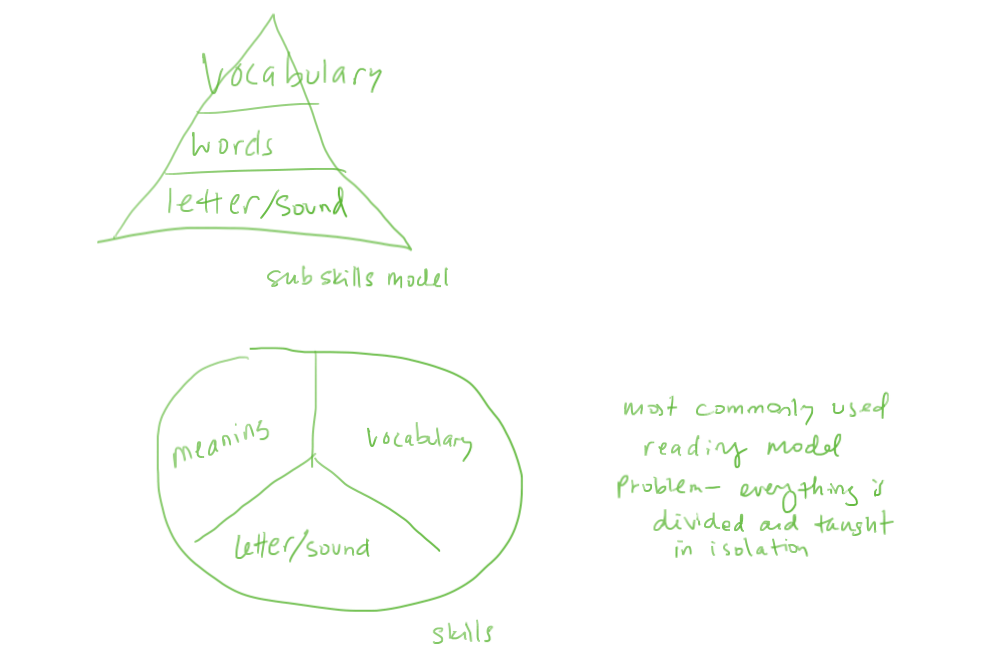
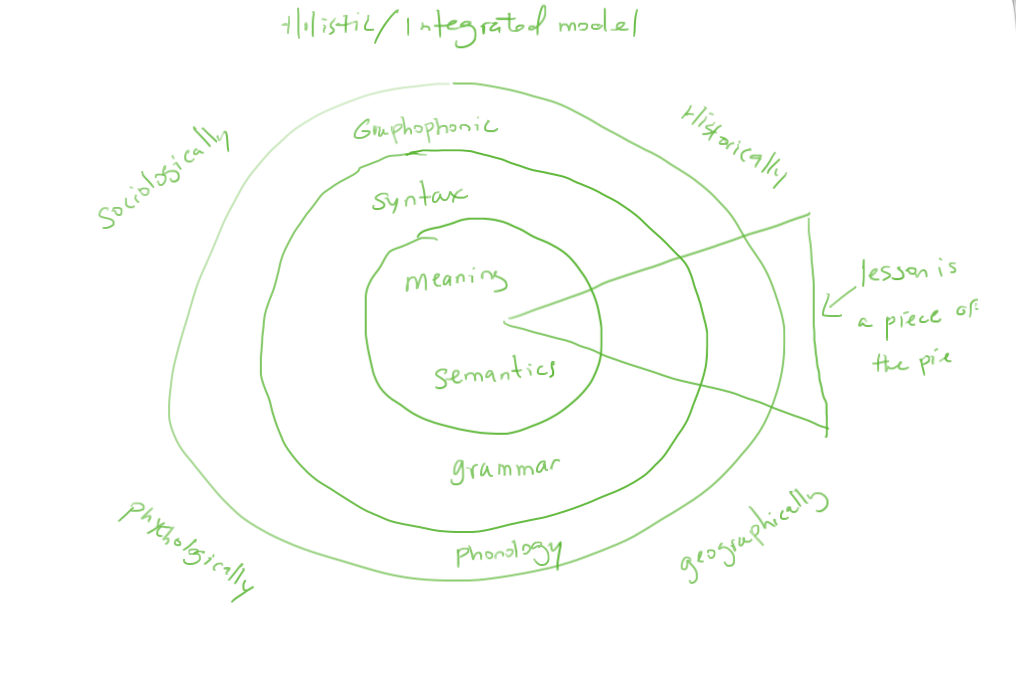
Reading Models
- Bottom-up mdoel
- Top-down model
- Interactive model
- Subskills model
- Skills model
- Holistic
Language Cuing Systems
Semantic cuing system
- The system of meanings in a language
- The question: Does this make sense?
- Interrelationships of words, sentences, and paragraphs within a coherent text.
- The question: Does this sound like language?
- The system of social rules that lets us know what language is acceptable and expected in particular settings. (Social knowledge)
- The question: what might someone say in this situation?
- The set of relationships between the sounds and the written forms of the language.
- The question: How do these letters and their sounds help me choose a word that makes sense here?
Goodman, Y., et. al. (2005). Reading Miscue Inventory. Katonah, NY: Richard C. Owens Publishers, Inc.
Miscue Analysis (in class)
When evaluating miscues, it's important to
- Syntactic Acceptablilty (Does this sound like language?)
- Semantic acceptability (Does this make sense?
- Meaning change?
- Graphic similarity (high, low, some)
High quality miscues (labeled YYN), those that show the children are making sense of what they're reading, usually have very low graphic similarity.
Low quality miscues usually have high graphic similarity because children are usually focusing too heavily on the graphophonic cuing system.
If a child self corrects, the coding of the miscue changes. Self-correcting is a YYN miscue. It's another reason we shouldn't interrupt children while they're reading. If we do, we eliminate the opportunity for the use of this strategy.
Saturday, August 28, 2010
Miscue Analysis
While RDG 621 is formally a class about literacy assessment and evaluation, the main assessment too that students learn and perform in this class is miscue analysis. Our class is held at New Mexico State's Children's Village, where we spend half the class learning about literacy by interacting with children.
Miscue analysis is a process developed by Ken Goodman (who wrote one of our textbooks). Simply put, it's the process used to determine both a reader's strengths and the strategies the reader needs to work on.
Unlike many assessment tools, miscue analysis is a mixed methods way of conducting research, possessing qualities that are both quantitative and qualitative. On the quantitative side, miscue analysis provides statistical information in the quantity and frequency of miscues. On the qualitative side, miscue analysis tells the evaluator about the quality of a reader's reading.
Right now, I have a working knowledge of the three cuing systems people use when they read. A fundamental understanding of these cuing systems is important when conducting miscue analysis. My goal for the semester is to build my knowledge of these cuing systems so when I am conducting an informal miscue analysis while listening to my students read, I can call up my knowledge of these cuing systems to help me further guide my students.
The three cuing systems are:
- Graphophonic: this system involves the way words are spelled, punctuation, and other print features, as well as the sounds of oral language and their relationship
- Semantic: this system deals with the meanings of words and phrases, how they relate to each other and both the author's and reader's knowledge of the world.
- Syntactic: this system involves the way people organize their words in phrases or sentences in any given language. The grammar of a language, if you will.
Goodman, Y., et. al. (2005) Reading Miscue Inventory. Katonah, NY: Richard C. Owen Publishers, Inc.
Subscribe to:
Posts (Atom)